

Lesson 1.3 Stalls
1. The angle of attack at which a wing stalls (critical angle of attack) remains constant regardless of
a. Weight
b. Dynamic pressure (a component of the Bernoulli equation, which explains lift in terms of pressure differentials)
c. Bank angle
d. Pitch attitude
2. Stall speed is affected by the airplane’s
a. Weight
b. Load factor
c. Power setting
3. The stalling speed is most affected by variations in airplane loading, i.e., weight and CG.
a. Design maneuvering speed, VA, is listed in the POH/AFM on all recently designed aircraft. VA defines the maximum speed at which an airplane can be safely stalled.
4. Turbulence can increase stall speed due to increased load factors.
a. Slowing to VA protects the airplane from excessive load stresses while providing a safe margin above stall speed.
5. Stall recovery becomes progressively more difficult when the CG moves aft.
6. Stall speed tables for various configurations at different angles of bank are provided for some airplanes, such as illustrated in Figure 2 below.
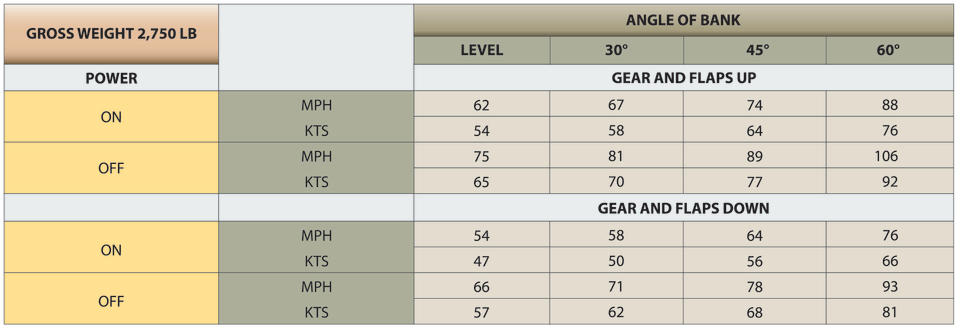
Figure 2. Stall Speeds
a. Note that the table portrays situations for a given weight at four angles of bank in two configurations (gear and flaps up or down) and with power on or off.
b. Note that stall speeds are generally lower with gear and flaps down.
c. Also, stall speeds are higher as bank increases.