

Lesson 1.7 Airplane Stability
1. Stability is the inherent ability of an object (e.g., airplane), after its equilibrium is disturbed, to return to its original position. In other words, a stable airplane will tend to return to the original condition of flight if disturbed by a force such as turbulent air.
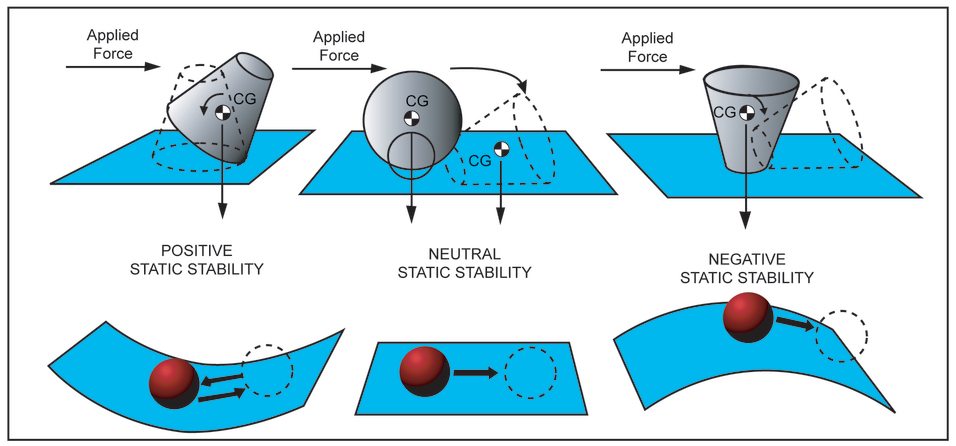
2. Static stability is the initial tendency that the airplane displays after its equilibrium is disturbed.
a. Positive static stability can be illustrated by a ball inside a round bowl. If the ball is displaced from its normal resting place, it will eventually return to its original position at the bottom of the bowl.
b. Neutral static stability can be illustrated by a ball on a flat plane. If the ball is displaced, it will come to rest at some new, neutral position and show no tendency to return to its original position.
c. Negative static stability is really instability. It can be illustrated by a ball on top of an inverted round bowl. Even the slightest displacement of the ball will activate greater forces, which will cause the ball to continue to move in the direction of the applied force (e.g., gravity).
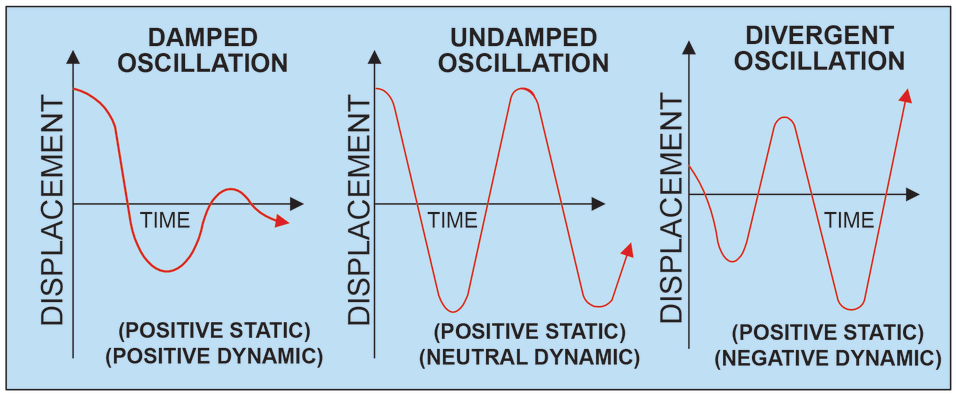
3. Dynamic stability is the overall tendency that the airplane displays after its equilibrium is disturbed.
a. Positive dynamic stability is a property that dampens the oscillations set up by a statically stable airplane, enabling the oscillations to become smaller and smaller in magnitude until the airplane eventually settles down to its original condition of flight.
b. Neutral dynamic stability means the oscillations remain unchanged.
c. Negative dynamic stability is actually dynamic instability. It means the oscillations tend to increase.
4. An airplane is said to have
a. Longitudinal stability about the lateral axis
b. Lateral stability about the longitudinal axis
c. Directional stability about the vertical axis
5. If an airplane is loaded to the rear of its CG range, it will tend to be unstable about its lateral axis.